Every chart on this page is simulated under stated assumptions. This is a study design, and it reports no findings from any platform.
The decision no dashboard reads
Every match a live-service shooter runs constitutes a squad around each player: who they fight beside, who carries, who talks, whose loadout they look at for ten minutes. That squad is where motivation is formed — to play another match, to come back tomorrow, to buy the thing a squadmate is wearing. The platform makes this decision millions of times a day, on connection and skill, and reads none of what it does to the people inside it.
Retention and engagement dashboards treat all playtime as the same. A player who loves the game and a player who is bored but has not found an exit both read as “active.” The first is durable value. The second is churn that has not posted yet — and at scale it is a large, invisible liability sitting inside the healthiest-looking number on the board.
Spend has the same problem. A purchase that forms inside a squad the player loves compounds. A purchase pushed by a composition that then dissolves is churn with a receipt: revenue this quarter, a lost player next quarter, and no dashboard that connects the two.
Who a player is placed with decides both. The question is whether what it produces holds.
What we read, from data you already have
The squad is the unit. Any small group runs on two levels at once: the group doing its actual work — coordinating, covering, playing as a team — and the group defending against the stress of being a group, in three recognizable patterns:
- Over-reliance on one carry. The squad leans on a single strong player and stops contributing; it holds together only while that player performs.
- Blame and scapegoating. The group needs an enemy and finds one among its own — toxicity, friendly fire where a playlist allows it, rage-quits that cascade.
- Cliques. Two players pair off and the rest orbit.
Which state dominates is set by how the squad was constituted: how lopsided contribution is, how wide the skill spread is, and — the amplifier — whether the squad is held together across matches or reshuffled every time. And each player carries a stable tendency to pull a squad one way or another, readable from play, separate from skill, so the toxic ace and the quiet anchor read as two different people where a rating merges them.
All of it is read from telemetry a shooter already records: objective time and score, assists, contribution per player, moderation and quit signals, party composition and whether party members have played together before, skill rating, and spend joined to the squad the player was in.
The experiment most franchises have already run
Two lobby designs are live in the market. One disbands the lobby after every match and sorts tightly on skill. The other keeps the lobby together match after match and matches on connection first, with a wider skill spread. Any franchise that has moved from one to the other has already run the experiment this design needs — a before-and-after on the two variables that matter, continuity and sorting, sitting in its own telemetry.
The predictions are registered before any data, each with the result that would prove it wrong.
| Prediction | Falsified if | |
|---|---|---|
| 1 | Under persistent lobbies, time spent as a working team rises with the number of consecutive matches a squad is held together; under disbanding it stays flat. | The teamwork share is flat in tenure under persistence, or disbanding squads reach the same share. |
| 2 | Persistence is a gain knob: a held-together squad deepens whichever state it opened in — teamwork and regression alike. | Persistence raises teamwork only and leaves the regressive states at chance. |
| 3 | Wider within-squad skill spread predicts more time in blame and over-reliance. | Skill spread is unrelated to regressive-state time. |
| 4 | A squad constituted around a high spender raises the other members’ purchase rate, net of playtime. | No lift once playtime is controlled and the high spender’s own purchases are excluded. |
| 5 | Spend that forms in a working squad holds; spend that forms in a squad in blame or over-reliance precedes exit. | Hold rate does not depend on the squad’s state. |
What the results would look like
We built the study before touching a row of anyone’s data: a simulation of the whole pipeline, run twice. Once in a world where composition matters as predicted (H1, blue), and once in a world where it does not (H0, orange), read through the same analysis. The point of the second run is that a reader can see the test is one that can fail.
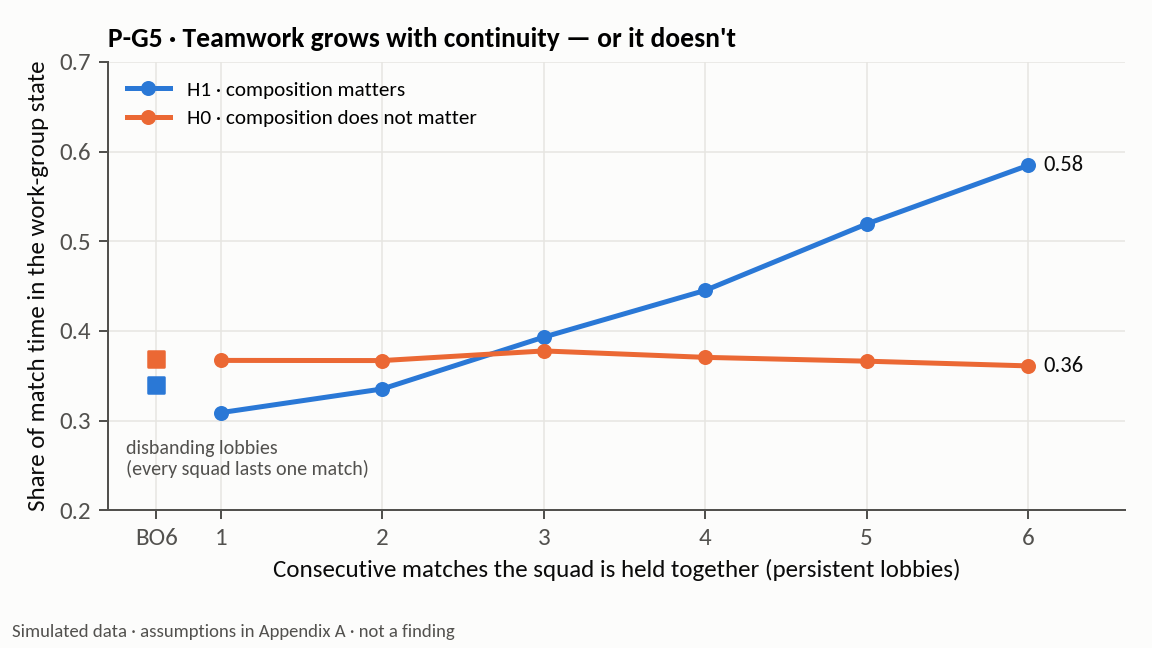
Continuity. In the H1 world the teamwork share climbs across six held-together matches; disbanding squads sit at their opening level. Under H0 the same pipeline returns a flat line. If real data look like the orange line, the continuity claim is false and the study says so.
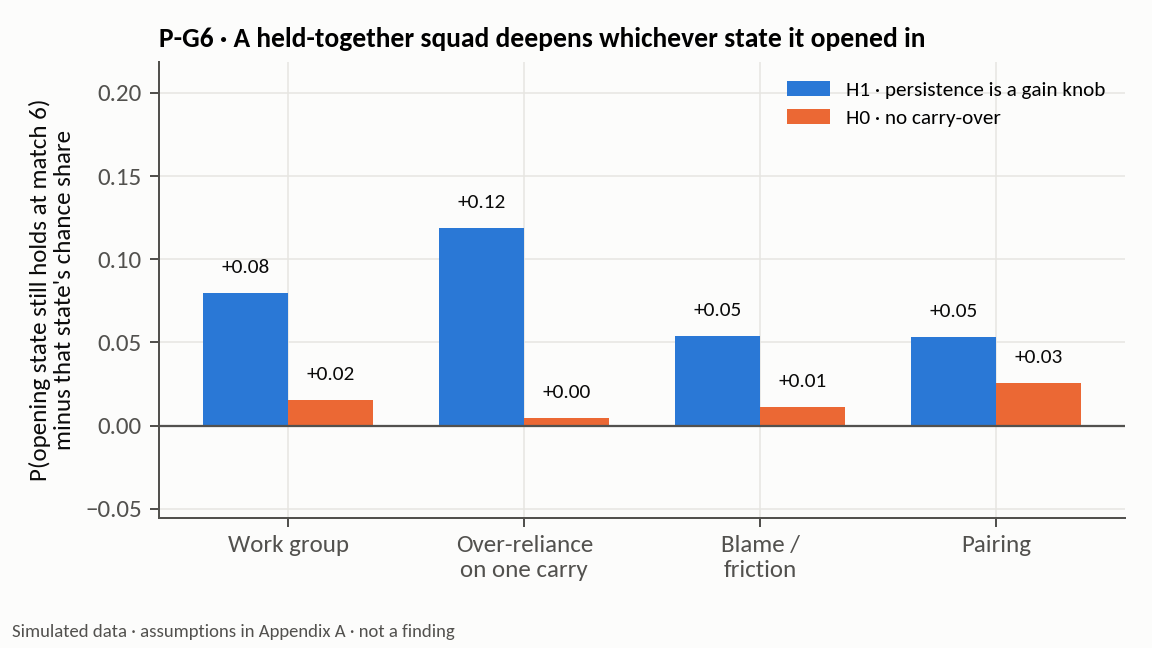
The gain knob. Persistence raises every state above its own chance share under H1 — teamwork, over-reliance, blame alike — and nothing under H0. Keeping a squad together amplifies whatever its opening minutes set, in both directions. Which is why “persistent lobbies” is a lever, and why the study reads what tips a persistent lobby toward the working state.
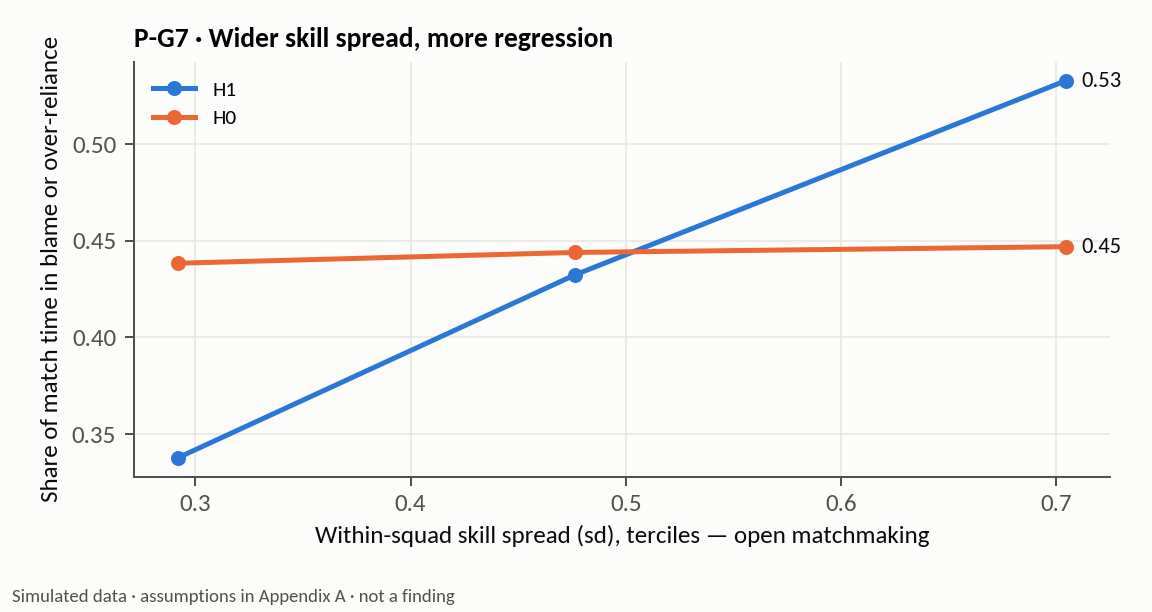
Skill spread. Regressive time rises with within-squad spread under H1 and stays flat under H0 — the read that says how far open matchmaking can widen the gap before a squad turns on itself.
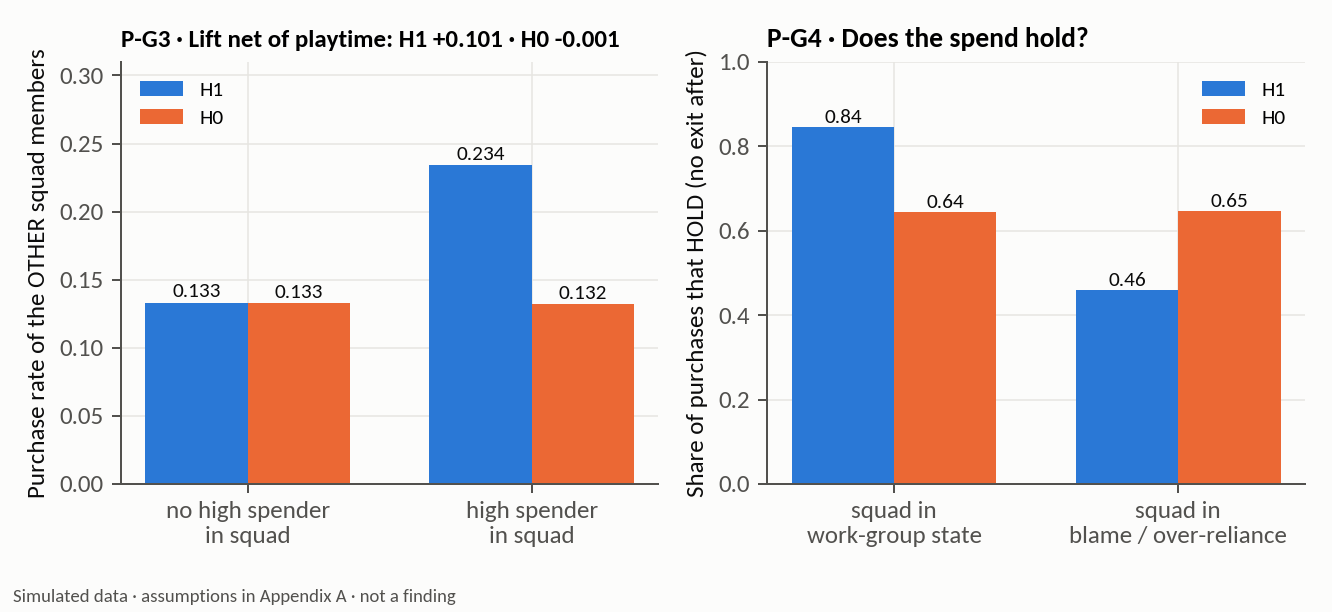
Buying potential, read as lift and hold together. Left: the purchase rate of the other squad members with and without a high spender present — the high spender’s own purchases are excluded, because otherwise the null manufactures a lift. Right: the share of purchases that hold, by the squad’s state. In the H1 world spend formed in a working squad holds at a high rate, and spend formed in a squad in blame at a low one; under H0 the two are identical. Composition can lift spend, and the squad’s state decides whether that spend is revenue or churn with a receipt.
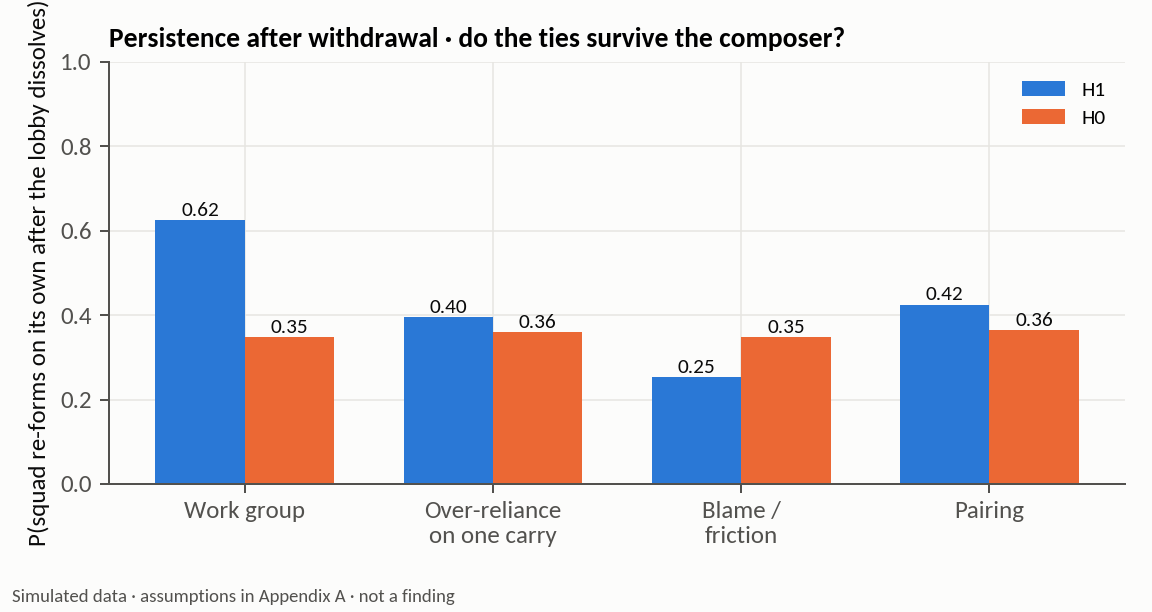
Persistence after withdrawal. Whether a squad re-forms on its own once the lobby dissolves, by the state it spent its block in. Ties that survive the composer are the cleanest single signal of durable satisfaction.
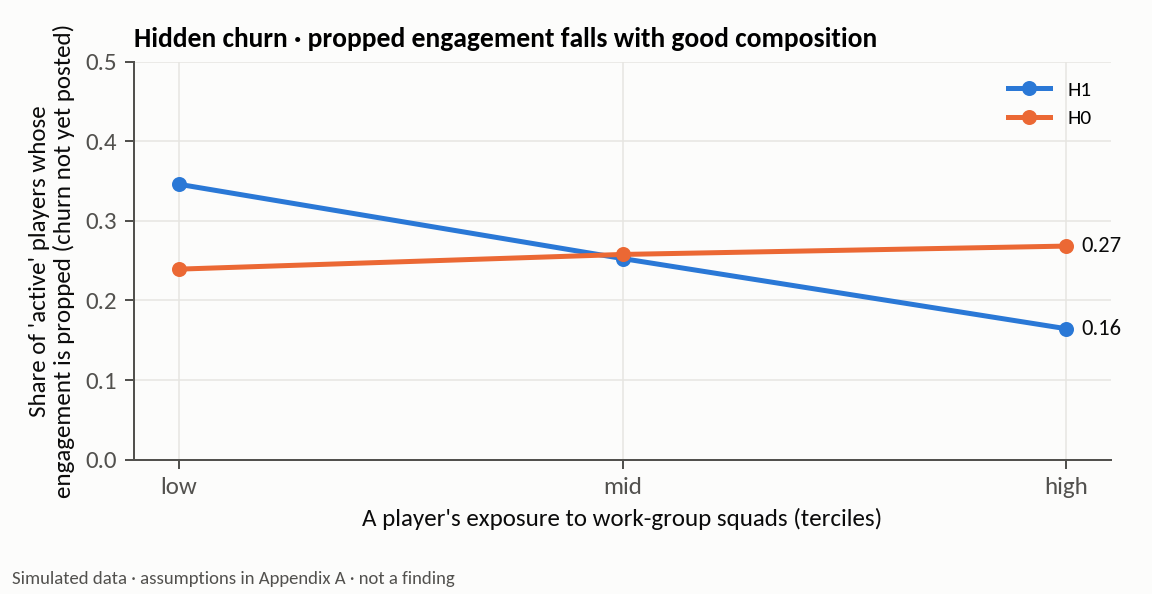
Hidden churn. The share of “active” players whose engagement is propped by the system and would not survive its removal, against the player’s exposure to working squads. The slope is the prediction; the level is an assumption of the simulation and says nothing about any real base.
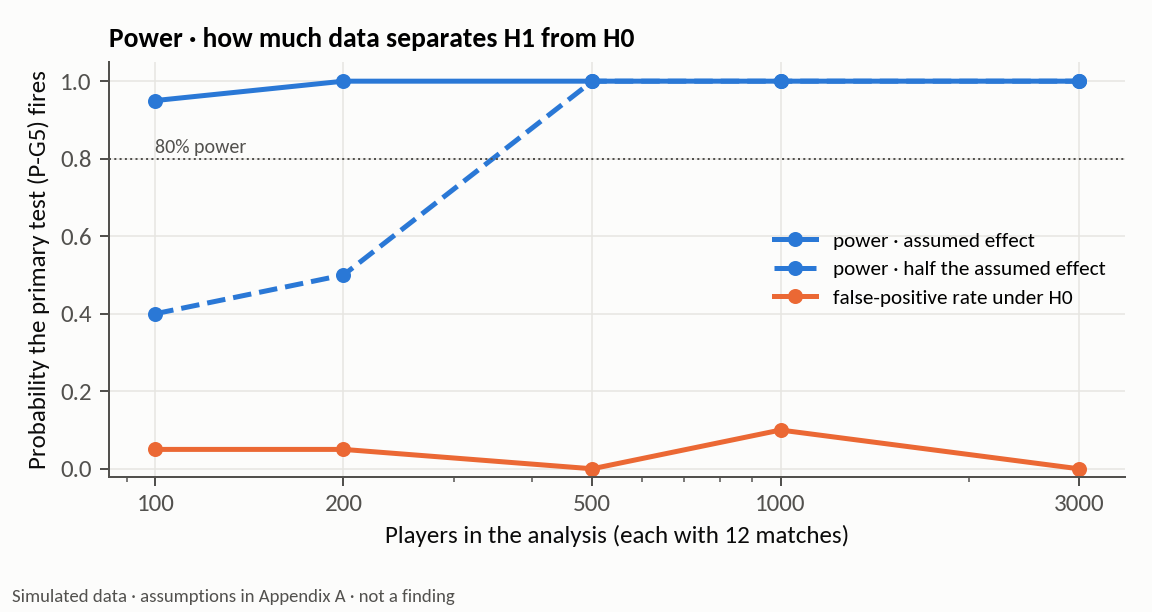
How much data. At the assumed effect size the primary test reaches 80% power with a few hundred players; at half the assumed effect, around five hundred. For any franchise at scale, sample size is a non-issue. The binding constraint is construct validity — whether the fitted states mean what the group science says — and the design carries an independent rating step to settle that before the states are given names.
Two rules the simulation taught before any data
Both came from watching the null misbehave, and both are now fixed rules of the analysis. The spend-lift test excludes the high spender’s own purchases; a squad “with a high spender” otherwise carries that player’s spend into the lift and manufactures an effect under H0. And each match’s state is read from that match’s own channels; a smoother that carries a persistence prior pulls the opening match toward the fitted average and manufactures a small trend under the null.
What a platform would need to record
Most of this design runs on fields a shooter already has. A handful would need to be instrumented, and each removes a limit the study would otherwise carry:
| Field | Typical status |
|---|---|
| Objective time and score; assists; contribution per player | exists |
| Moderation and chat flags; early leaves and quits; friendly fire by playlist | exists |
| Party / squad id; “played together before” | exists |
| Skill rating; per-player spend joined to the squad | exists |
| Party formation timestamp; mid-session membership change (backfill) | instrument |
| Squad persistence across matches (held vs reshuffled) | derivable or instrument |
| Re-queue-together after dissolution; friend adds; cross-session co-play | instrument |
| Callouts and pings acted on | instrument |
| Within-match event timeline | instrument |
What Dividual does with this
This is the shape of the work we do: read the squad, read the player’s tendency, and separate what holds from what only looks like it does — for retention and for spend, on data the platform already collects. A first phase is observational and touches no live system. Predictions are registered before the data is opened, with the result that would falsify each. Deliberate compositions come later, under controls, only if the first phase earns them.
If your franchise has changed how it constitutes lobbies — or is about to — the experiment is already in your telemetry. Keep more of the players you’ve already won.
Simulation code, assumptions, and figures available on request. Nothing here reports a finding from any platform.